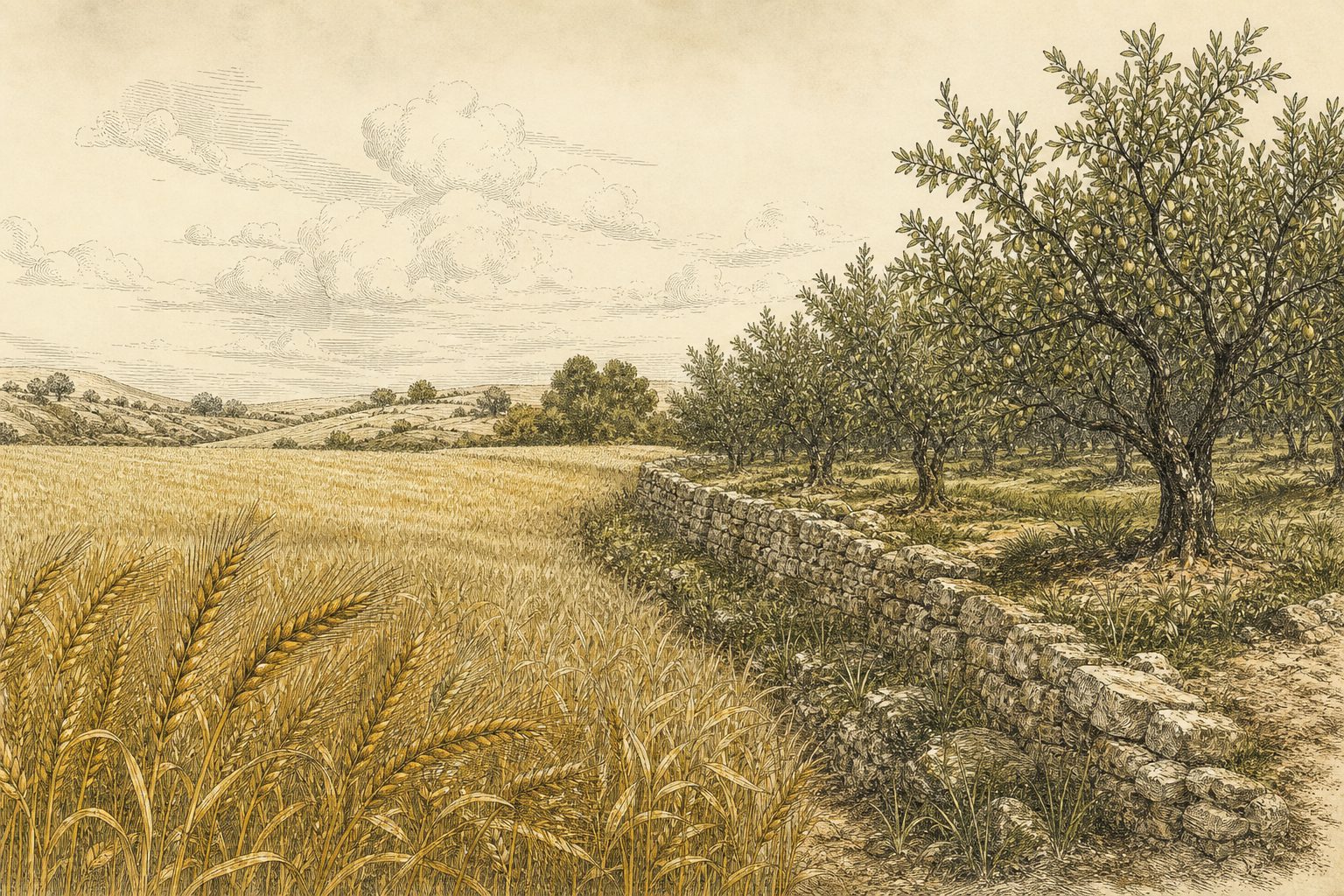
The agricultural commands, and the questions they raise on real ground
Torah on the land
Torah contains a great deal of agricultural law, and almost nobody serves the people trying to keep it.
Secular homesteading sites, and there are hundreds, never mention it. Teaching sites handle it doctrinally, as a matter of position. Neither answers the question an actual household asks on an actual piece of ground:
I have four acres. What does Torah require of me here?
These pages exist for that question. Each one sets out what is written, in full, and then states plainly the practical problem it creates for someone growing food and keeping animals.
What these pages do not do
They do not rule.
On several of these commands, people who keep Torah faithfully and carefully disagree about whether a command applies outside the Land, about what counts as sowing or mixing, about where a tithe goes when no temple stands. Flattening that into a single answer would be dishonest, and it would drive away most of the people these pages exist to reach.
So each page presents the text and the question, and leaves the position and the range of practice to be published by the owner and worked out in the assembly. That is open territory, not the settled core.
Where doctrine and prophecy live
This site is the walk, the land, and the people. It does not re-argue what is taught elsewhere.
- Teaching, the restored Bible, and study material: truthcarriers.com
- The prophecy case and the timeline: messiah2027.com
If you arrived here to settle a doctrinal question, those are the places. If you arrived because you already believe it and now want to do it on a piece of ground, and to stop doing it alone, you are in the right place.
The commands
-
Firstfruits and tithes
The tithe of the land is set apart. With no temple standing, what does a household actually do?
-
Shatnez: wool and linen
Irrelevant until you keep sheep and grow flax. Then it decides what the household can make.
-
Working animals
Two short commands that shape how draft animals are paired and fed while they work.
-
Slaughter
A household raising its own meat runs straight into commands no secular homesteading source mentions. The blood is the whole question.
-
Sabbath with livestock and a garden
The animals still need feeding and the cow still needs milking. What the household actually does on the seventh day.
-
Clean livestock: which animals are worth raising
The chapter that quietly rules out most homesteading content, because most of it assumes pigs.
-
Pe'ah and gleaning: the corners and the forgotten sheaf
Leave the corners, the gleanings, and what you forgot. Straightforward on a wheat field; less obvious on four acres.
-
Shmita: the land sabbath
Every seventh year the land rests. The hardest command to keep on a homestead, and the one that must be planned years ahead.
-
Orlah: the first years of a fruit tree
Three years forbidden, the fourth year set apart, the fifth year yours. This reshapes an orchard plan before you plant it.
-
Kilayim: mixed seed and mixed kinds
No sowing two kinds of seed. The question every polyculture gardener runs into on day one.